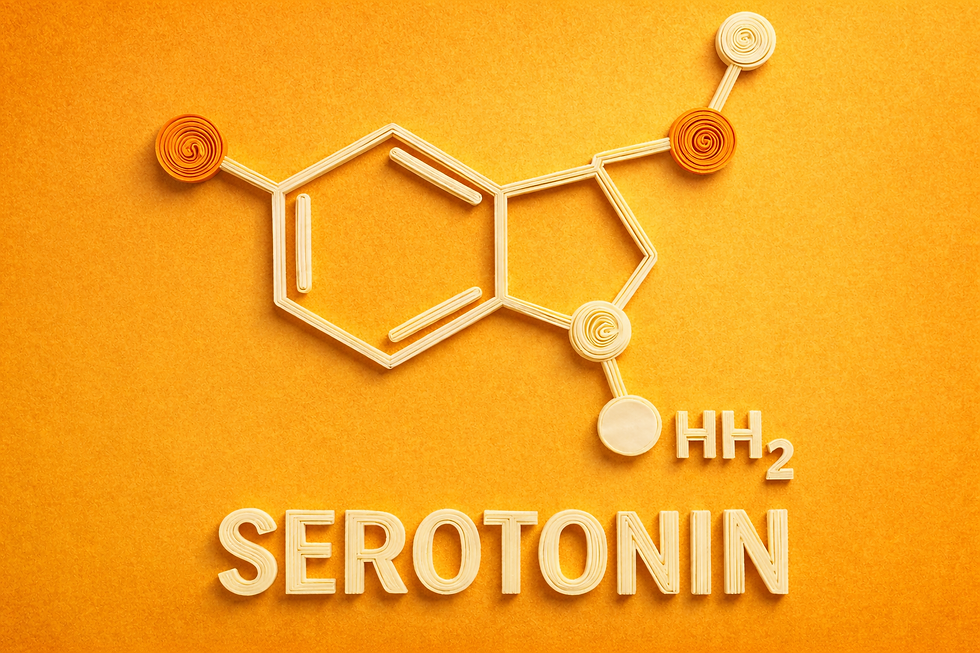
The Serotonin Myth: New Research Challenges Decades of Mental Health Messaging
Updated: Feb 20
Summary: A major umbrella review from University College London challenges the long-held belief that depression is caused by low serotonin levels. The study found no convincing evidence supporting the “chemical imbalance” theory, despite decades of public messaging and drug marketing built around it. While antidepressants can still help many people, the findings highlight that depression is far more complex — influenced by psychological, social, and environmental factors — and encourage a broader, more holistic approach to mental health care.
For years, the public has been told a simple story: depression is caused by a chemical imbalance in the brain, specifically low levels of serotonin. This idea has shaped everything from mental-health awareness campaigns to pharmaceutical marketing — and for many, it became the defining explanation for why depression happens.
But a major new study is calling that long-accepted narrative into question, and the implications are profound.
Researchers at University College London (UCL) recently published a landmark umbrella review in Molecular Psychiatry, analyzing decades of data on depression and serotonin. Their conclusion: there is no convincing evidence that low serotonin levels cause depression. In fact, some findings suggest that long-term use of certain antidepressants may reduce serotonin activity.
This is especially striking because many of the world’s most commonly prescribed antidepressants — SSRIs (Selective Serotonin Reuptake Inhibitors) — are built on the assumption that boosting serotonin helps alleviate depressive symptoms. If the serotonin-deficiency theory lacks scientific support, it raises important questions about how these medications work and whether they’ve been marketed on an oversimplified premise.
According to the researchers, up to 90% of the public still believes in the “chemical imbalance” explanation. While comforting in its simplicity, this idea can unintentionally limit our understanding of depression, making it seem like a purely biological flaw. In reality, depression is shaped by a complex mix of psychological, emotional, social, and environmental factors.
This misunderstanding may also lead people to overlook effective non-drug treatments — such as psychotherapy, trauma-informed approaches, lifestyle changes, and strengthening social support systems.
Crucially, the study does not claim that antidepressants never work. Many individuals experience genuine relief while taking them, and mental health is highly personal. Instead, the findings encourage a more nuanced, compassionate, and holistic approach to understanding depression — one that respects both biology and life experience.
Mental health is not defined by one molecule. It is influenced by relationships, stress, trauma, environment, genetics, and more. Embracing this complexity opens the door to more effective and human-centered care.
Source:“The serotonin theory of depression: a systematic umbrella review of the evidence,” Molecular Psychiatry (2022).Lead authors: Joanna Moncrieff et al., University College London (UCL).